Have you ever noticed the disconnect between the enchanting aroma of coffee filling the kitchen in the morning and the bland taste in your cup? Coffee experts suggest the real cause of this disappointment is rarely the beans, but rather habitual brewing mistakes. This guide is designed to solve exactly that problem. Even with a standard filter coffee machine, minor tweaks can help you capture the smooth flavor you seek at specialty cafes.
Gastronomy research shows the secret to a perfect cup is extraction balance—getting the right ratio of good aromas into the water. Successful home brewing relies on three golden rules: fresh beans, ideal water temperature, and the correct grind size. Once you grasp these fundamentals, you will bring a true specialty coffee experience into your kitchen, eliminating the need for added sugar.
Choosing Fresh Beans: Treat Coffee Like Freshly Baked Bread
You likely know coffee is a fruit pit; but did you know it stales when exposed to air, oxidizing much like a sliced apple? That is why the "roast date" is always the primary criterion for selecting fresh beans. The ideal consumption window for these beans, which lose aroma as they sit, is between the second and fourth weeks after roasting.
You might look at the chocolate or wild berry notes on packages and wonder which beans are best. Reading coffee tasting notes is quite simple; these notes do not represent artificial syrups added later, but the bean's natural character drawn from the soil.
The only way to preserve this natural character with the freshness of just-baked bread is to buy whole beans and grind them immediately before brewing.
Sand or Gravel? Capturing Aroma with the Right Grind Size
The process of water filtering through coffee particles to carry aromas into your cup is called "extraction." If you grind the beans as fine as flour, water cannot pass through and dissolves unwanted flavors; this over-extraction is the primary reason filter coffee turns bitter. Conversely, if the particles are as coarse as gravel, water flows through too quickly; this under-extraction leaves a bland, sour taste in your cup.
To achieve the perfect flavor, you must understand your equipment and determine the grind size based on your brewing method:
- French Press: Coarse (size of coarse sea salt)
- Paper Filter Machine: Medium (like coarse sand, the ideal setting for standard machines)
- V60: Medium-fine (slightly coarser than table salt)
The Mathematics of Flavor: Ideal Coffee-to-Water Ratio and Water Quality
Rather than leaving your favorite morning flavor to chance, entrust it to a golden formula. The globally recognized 1:16 rule is the foundation for calculating the ideal coffee-to-water ratio; use 1 gram of coffee for every 16 milliliters of water. If you do not have a kitchen scale, a heaping standard tablespoon equals roughly 10-12 grams.
A practical weight calculation guide for your specific mug or brewer is as follows:
- 250 ml (Standard mug) of water: ~15 grams of coffee
- 350 ml (Large mug) of water: ~22 grams of coffee
- 500 ml (Two-person) of water: ~31 grams of coffee
Once the measurements are correct, water quality and temperature become crucial, as brewing water impacts the taste just as much as the bean type. Boiling water scorches the coffee, so wait 1-2 minutes after boiling before pouring. Using equipment that heats water to optimal brewing ranges (around 90-96°C) is critical for maintaining flavor integrity.
Paper or Metal? Filter Selection and Equipment Comparison
The character of the coffee in your cup completely changes depending on the filter you use. The difference between paper and metal filters fundamentally comes down to "body"—the feeling of fullness on the palate—and "sediment," the fine dust at the bottom of the cup. Paper traps coffee oils and offers a crisp, clear brew, while metal filters allow oils to pass through, creating a heavier, more intense flavor profile.
If you choose paper for a smoother taste, do not skip rinsing the filter with hot water before brewing; this simple step instantly eliminates any unwanted papery taste. For those who prefer avoiding disposable items, brewers with built-in stainless steel mesh or washable, reusable filters offer highly practical, long-term alternatives.
The Art of Brewing: The Blooming Process and Step-by-Step Preparation
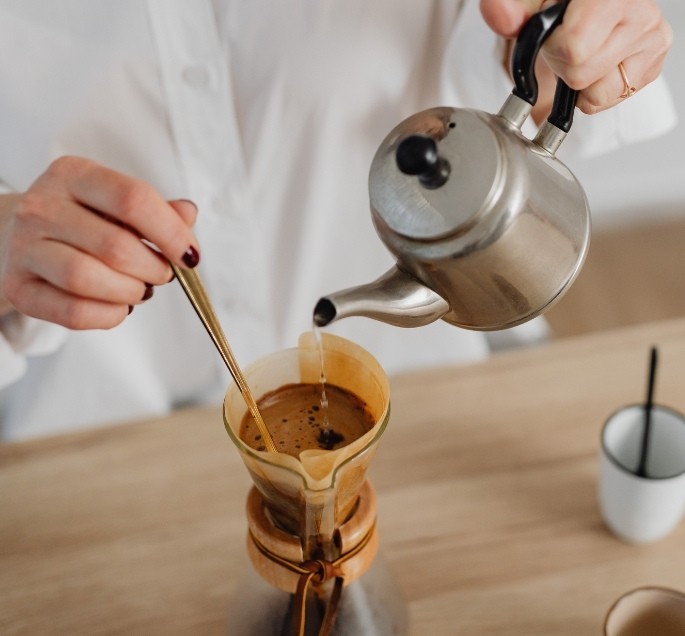
The moment water first meets coffee is when the beans awaken. When you pour the water, you will see the coffee bubble and swell; this is called blooming. The gases trapped during roasting are released (degassing). If this gas does not escape, water cannot penetrate the bean, and bright aromas remain locked away. Pouring water slowly in a circular motion creates a gentle turbulence in the coffee bed, ensuring an even dissolution of flavors. The impact of blooming on flavor is the foundation of that signature smoothness.
The structural differences between manual brewers dictate your pouring speed; a high-quality automated brewer regulates this process for you. Regardless of the method, the total brewing time should generally not exceed 4 minutes to prevent bitter flavors from extracting. A standard rhythm you can apply at home is as follows:
- 0:00-0:45: Pour twice the coffee's weight in water and wait (Blooming).
- 0:45-1:45: Slowly pour half of the remaining water in circular motions.
- 1:45-3:00: Add the final water and allow it to completely drain.
Troubleshooting: Correcting Unbalanced Flavors
You bought great beans and followed all the steps, but grimaced at the first sip. This is usually caused by water finding an easy path through the coffee bed and flowing too quickly, a phenomenon known as channeling. When water does not touch all the grounds evenly, unbalanced flavors emerge.
To correct errors in the flavor profile, use this simple intervention matrix:
- If the coffee is too bitter: Water struggled to pass through fine grounds, extracting bad flavors; grind the beans coarser next time.
- If the coffee is sour and watery: Aromas did not fully extract; slightly increase the water temperature or grind finer to draw out the flavors.
Even with the best technique, a poorly cleaned brewer will carry the bitterness of stale oils from previous uses into your cup. Maintaining equipment hygiene and storing beans in airtight, opaque containers will entirely remove these undesirable tastes.
Establishing Your Own Coffee Ritual
You are now equipped to turn an ordinary morning routine into a masterful ritual. Tomorrow morning, start by letting boiling water rest for a minute and using freshly ground beans. By adjusting the variables of grind size, ratio, and water temperature to your needs, you can refine the home brewing process to perfectly match your palate.
Remember, the perfect cup is not a final destination, but an enjoyable journey of discovery. Every minor adjustment brings you closer to consistently delicious results. Simply heat your water, brew with the confidence of new knowledge, and savor the distinct aromas waiting in your cup.